Divorce in Malaysia: Understanding the Difference Between Joint and Single Petitions
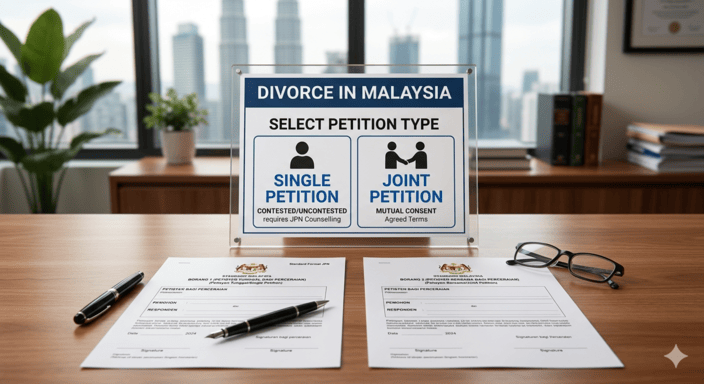
When people first consider divorce, one of the most common questions they ask is:
“Should I file a Joint Petition or a Single Petition?”
While this appears to be the most important decision at the beginning of the process, it is often not the right question.
In practice, many individuals do not encounter difficulties because they chose the wrong type of divorce proceeding. Rather, they encounter difficulties because they misunderstand the sequence of steps involved and commence the process without first understanding their legal position.
A clear understanding of the available options can save significant time, expense and emotional stress.
Joint Petition: When Both Parties Agree
A Joint Petition is generally the most straightforward method of obtaining a divorce.
As its name suggests, both spouses jointly apply to the Court for the dissolution of the marriage.
This option is typically available where both parties have already agreed that the marriage has irretrievably broken down and have reached agreement on the key issues arising from the separation.
These issues commonly include matters such as custody of children, access arrangements, maintenance and the division of matrimonial assets.
Because the parties have already reached an agreement, the Court’s role is largely focused on reviewing the terms and determining whether the proposed arrangements are appropriate and lawful.
In most cases, a Joint Petition is faster, less costly and considerably less stressful than contested proceedings.
For that reason, where an amicable resolution is possible, it is often the preferred option.
Single Petition: When Agreement Is Not Possible
Not every marriage ends on mutually agreeable terms.
There are many situations where one spouse refuses to cooperate, disputes the divorce, delays discussions or simply cannot be located.
In such circumstances, a Single Petition may become necessary.
Unlike a Joint Petition, a Single Petition is commenced by one spouse without the agreement of the other.
Because the proceedings are contested, the Court will ultimately be required to consider the evidence and determine whether the legal requirements for divorce have been satisfied.
Single Petition proceedings are generally more time-consuming and involve a greater degree of procedural complexity than a Joint Petition.
For this reason, legal advice is particularly important before commencing such proceedings.
The Role of the Marriage Tribunal and KC28
Many people have heard of a document commonly referred to as “KC28” but are uncertain about its purpose.
The KC28 is essentially a certificate issued following the failure of reconciliation efforts conducted through the Marriage Tribunal established under the relevant legal framework.
Its purpose is to demonstrate that attempts at reconciliation have been made but have not succeeded.
In many non-Muslim divorce matters, this certificate forms an important part of the process before contested divorce proceedings may proceed. However, there are statutory exceptions, and the requirement does not apply in every case.
Whether a KC28 certificate is required depends on the specific facts and legal circumstances involved.
As a result, professional advice should always be obtained before assuming that attendance before the Tribunal is mandatory.
Where Children Are Involved
In our experience, the most difficult disputes in divorce proceedings rarely concern the divorce itself.
More often, they concern the children.
Questions regarding custody, care arrangements, visitation rights and maintenance frequently become the central issues between the parties.
For this reason, where children are involved, it is often beneficial to focus on resolving parenting arrangements as early as possible.
Once practical arrangements concerning the children have been agreed upon, many couples find that the remaining issues become easier to resolve.
In some situations, matters that initially appeared destined for contested proceedings ultimately proceed by way of a Joint Petition after agreement has been reached on issues affecting the children.
This approach often reduces conflict and allows both parties to focus on the long-term welfare of their children.
Why Timing Matters
One reality of family law practice is that delay can sometimes become a strategy.
Many individuals have experienced situations where discussions continue indefinitely without any real progress.
Promises are made to revisit the issue later. Decisions are postponed. Months turn into years.
Meanwhile, uncertainty continues.
One reason lawyers frequently advise clients to understand and, where appropriate, commence the correct legal process is to prevent matters from remaining unresolved indefinitely.
The objective is not to create conflict but to establish a clear framework within which issues can be addressed and resolved.
Understanding the Process Before Taking Action
Every divorce matter is different.
Some cases can be resolved through cooperation and mutual agreement. Others require judicial intervention. Some involve complex financial issues. Others revolve primarily around parenting arrangements.
The key is not to assume that every divorce follows the same path.
Before deciding whether to pursue a Joint Petition or a Single Petition, it is important to understand the legal requirements, the available options and the practical consequences of each approach.
A properly planned strategy at the beginning of the process often prevents unnecessary complications later.
Divorce Is Not Merely a Legal Procedure
It is important to remember that divorce is not simply about ending a marriage.
It often involves decisions that will affect housing arrangements, financial security, parental responsibilities and the future well-being of children.
For that reason, the objective should never be to complete the process as quickly as possible at any cost.
The objective should be to ensure that the process is handled properly and that the long-term consequences are carefully considered.
Conclusion
The distinction between a Joint Petition and a Single Petition is important, but it is only one part of the overall picture.
The more important question is whether the process has been approached in the correct manner from the outset.
Where agreement is possible, a Joint Petition will often provide the most efficient and cost-effective solution.
Where agreement is not possible, a Single Petition may be necessary to move matters forward and allow the Court to determine the issues in dispute.
Ultimately, understanding the procedure is not about encouraging divorce.
It is about ensuring that when individuals find themselves facing one of the most difficult periods of their lives, they are able to make informed decisions and avoid unnecessary mistakes.
In family law matters, the right first step often determines the entire journey that follows.
This article is general information about Malaysian law and is not legal advice. Every matter turns on its own facts — please speak to us about your situation.