Letters of Administration (LA) in Malaysia: A Practical Guide to Estate Administration Without a Will
When a loved one passes away without leaving a valid will, one of the first legal questions the family will face is this:
Who has the legal authority to deal with the deceased’s assets?
Many people assume that a spouse or child can automatically access bank accounts, transfer property or deal with the deceased’s affairs. Unfortunately, that is not how the law operates.
In Malaysia, where a person passes away without a will, the family will generally need to obtain a Letter of Administration (“LA”) before the estate can be properly administered.
Understanding the purpose of an LA and the process involved can save families significant time, expense and unnecessary disputes.
What Is a Letter of Administration?
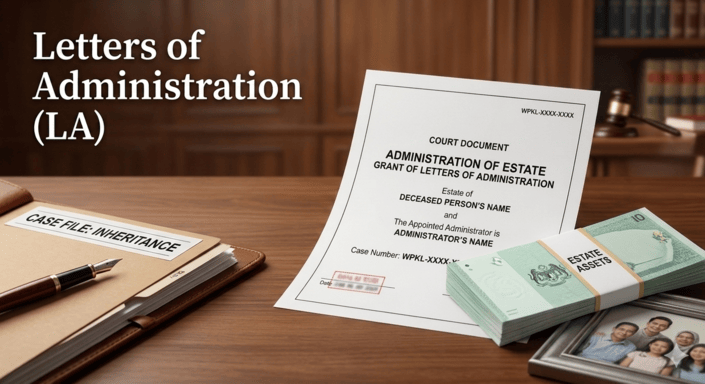
A Letter of Administration is a court order issued by the High Court authorising one or more individuals to administer the estate of a deceased person who died without a valid will.
The person appointed by the Court is known as an administrator.
Once appointed, the administrator assumes legal responsibility for collecting the deceased’s assets, settling liabilities, dealing with financial institutions, managing estate matters and ultimately distributing the estate to the rightful beneficiaries in accordance with the law.
Without an LA, family members often discover that they have no legal authority to deal with the deceased’s assets, even if they are the spouse or children of the deceased.
When Is a Letter of Administration Required?
A Letter of Administration is commonly required whenever a deceased person leaves behind assets but does not leave a valid will appointing an executor.
In practice, applications are frequently necessary where the deceased owned real property, maintained bank accounts, held investments, owned motor vehicles or left behind other significant assets that cannot be transferred without formal legal authority.
The larger or more complex the estate, the more likely it is that an LA will be required.
Who Can Apply?
The Court generally gives priority to individuals who have a legitimate interest in the estate.
In most cases, applications are made by a surviving spouse, children, parents or other close family members.
The objective is to appoint a suitable individual who is capable of administering the estate responsibly and in the interests of all beneficiaries.
The Court’s concern is not merely who wishes to act, but whether the proposed administrator is appropriate for the role.
Choosing the Right Administrator
Although the law permits multiple administrators to be appointed, practical experience often demonstrates that more administrators do not necessarily result in a smoother administration process.
Every significant decision generally requires cooperation between the administrators.
Where disagreements arise, estate administration can become delayed and increasingly complicated.
For this reason, careful consideration should be given to the number of administrators proposed. The objective should be efficient administration rather than unnecessary complexity.
The First Priority Is Identifying the Beneficiaries
One of the most common misunderstandings is that the first issue to resolve is how the estate will be divided.
In reality, the first task is often determining who is legally entitled to benefit from the estate.
Before assets can be distributed, the beneficiaries must be properly identified and their relationship to the deceased established.
This forms the foundation upon which the entire administration process is built.
Renunciation Does Not Mean Giving Up an Inheritance
Where several family members are entitled to apply for the grant, it is common for some individuals to choose not to act as administrators.
In such circumstances, renunciation documents may be executed.
A renunciation generally means that the individual is giving up the right to act as an administrator.
It does not necessarily mean that the individual is giving up his or her entitlement to inherit from the estate.
This distinction is important and is frequently misunderstood.
What Happens If Someone Objects?
Families often worry that an objection from one beneficiary will automatically prevent the estate administration process from moving forward.
The reality is more nuanced.
Where disputes arise, the Court has mechanisms available to address them. Depending on the circumstances, the Court may require the objecting party to explain the basis of the objection and determine whether it is legally sustainable.
Not every objection will prevent an application from proceeding.
Ultimately, the Court’s objective is to ensure that the estate is properly administered rather than left indefinitely unresolved.
Obtaining the Grant Is Not Always the End
Many people believe that once the Letter of Administration has been issued, the estate administration process is complete.
In reality, obtaining the grant is often only the beginning.
The administrator must still collect assets, settle liabilities, deal with financial institutions, transfer ownership of property and complete the distribution process.
Where land or real property is involved, additional applications or procedures may be necessary before ownership can be formally transferred to the beneficiaries.
This is one reason why estate administration should be viewed as a process rather than a single application.
Preparation Is Essential
A successful application depends heavily on proper preparation.
The availability of death certificates, property documents, banking information and records identifying the beneficiaries will often determine how smoothly the process proceeds.
The earlier these documents are assembled, the easier it becomes to administer the estate efficiently.
Delays frequently occur not because of legal complications, but because important information cannot be located after many years have passed.
Why Early Action Matters
One lesson remains consistent across almost every estate administration matter.
The longer an estate remains unattended, the more difficult it usually becomes to administer.
Documents become harder to locate. Family relationships change. Beneficiaries relocate. Assets may become difficult to trace. Disputes that did not previously exist begin to emerge.
For this reason, families are generally well advised to address estate administration issues sooner rather than later.
Prompt action often reduces cost, minimises conflict and preserves valuable evidence and documentation.
Conclusion
A Letter of Administration is far more than a legal formality.
It is the mechanism through which the law authorises a person to step into the shoes of the deceased and properly administer the estate.
Without it, many assets cannot be accessed, transferred or distributed.
While the process may appear intimidating at first, most difficulties arise not from the legal procedure itself but from delays, missing documents and misunderstandings among family members.
Estate administration is ultimately about bringing certainty to a family’s affairs during a difficult period.
The earlier it is addressed, the easier that process usually becomes.
Because in estate matters, time rarely solves problems. More often, it creates them.
This article is general information about Malaysian law and is not legal advice. Every matter turns on its own facts — please speak to us about your situation.